(Re)AniMa | Cascadia –– Re visiting/purposing/storying Animate Matter
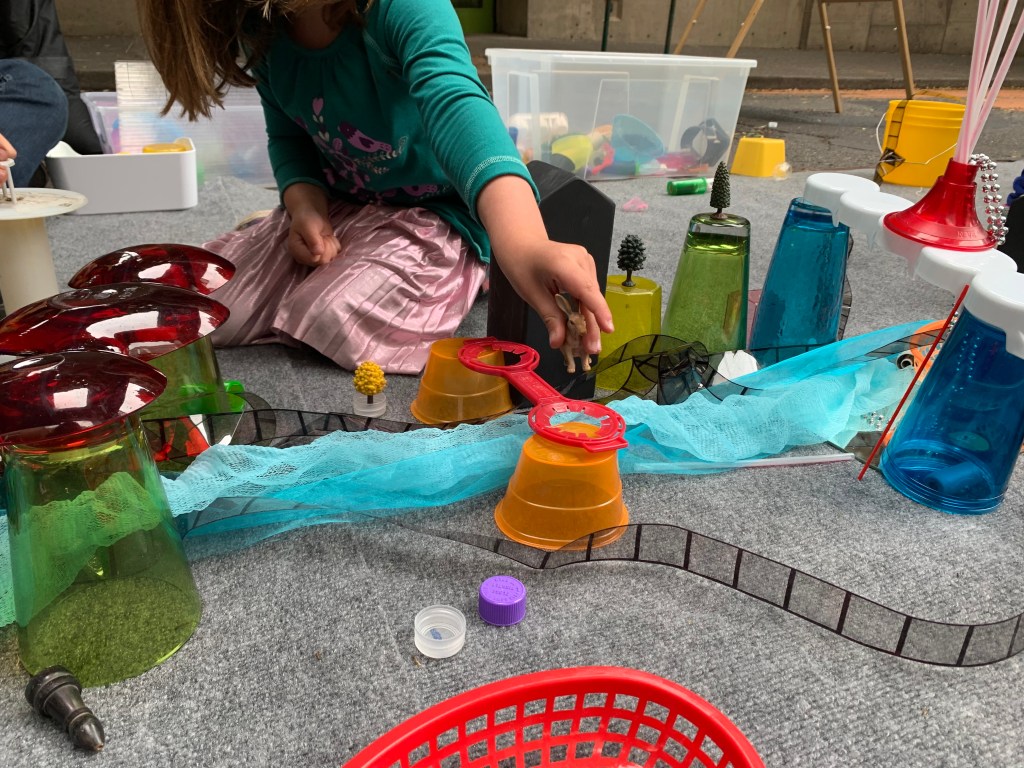
(Re)AniMa | Cascadia is a project for creative reuse developed in 2026 by Dr. Angela Molloy Murphy for a course at Capilano University, Children, Place, and Waste. (Re)AniMa | Cascadia is inspired by ReMida Reggio, a creative reuse center in Reggio Emilia Italy established in 1996, Inventing ReMida Portland Project (IRPP), and the hundreds of creative reuse projects that have emerged throughout the world since, including ECPN and ECBC’s ongoing RE:MATERIA program.
The purpose of (Re)Anima | Cascadia is to revisit, repurpose, and restory discarded materials in early childhood contexts and beyond as a multimatter/multispecies form of planetary care (Molloy Murphy, 2024). In the pursuit of social, ecological, and planetary justice, waste can be a theoretical and practical companion, inviting us to consider what is commonly discarded and what is treasured, and why. (Molloy Murphy, 2020). Cascadia is invoked in the project title with the intent to make space for partnerships in Washington, Oregon, and Northern California, and in Portland where Dr. Molloy Murphy first found her way to this work with William Parnell, Ellie Justice, and Michelle Domingues at IRPP.
Inspired by annual ReMida Day events in Reggio Emilia, (Re)AniMa | Cascadia’s first event, will be June 13, 2026. Children, educators, families, students, and the public will be invited to participate in encounters with place and waste in multiple settings throughout British Columbia and the Cascadia region to explore speculative possibilities for place and waste relations on stolen land.
“We” are in this together, but we are not one and the same.” (Braidotti, 2020).
References
Braidotti, R. (2020). Journal of bioethical inquiry, 17(4), 465-469.
Molloy Murphy, A. (2024). What world is knocking? Responding to a world in crisis with polyphonic storying. Australian Journal of Environmental Education, 40(2), 322-339.
Molloy Murphy, A. (2020). Plastic City: A Small-Scale Experiment for Disrupting Normative Borders. eceLINK Common Worlding in Early Childhood Education Special Issue, 4(1), 14
 Dr. Angela Molloy Murphy